
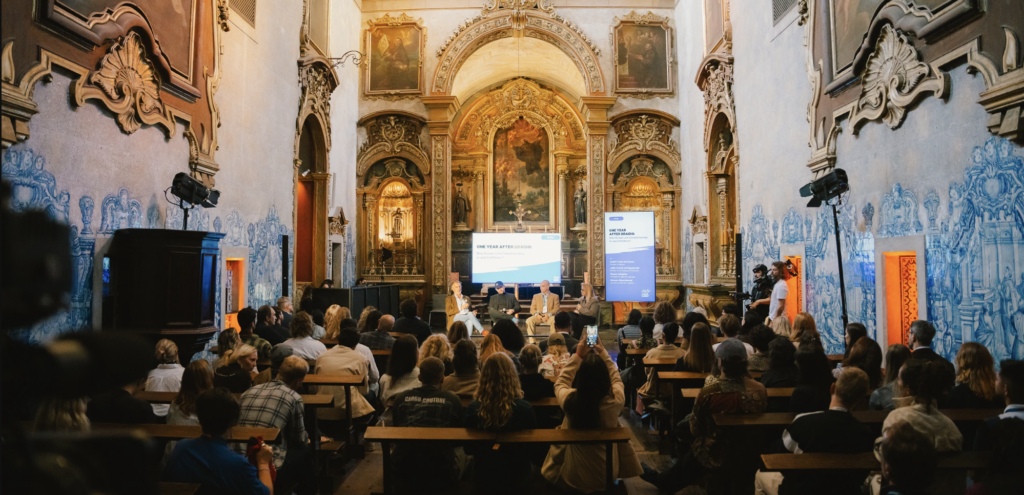
Lisbon, November 2026 – At the Startup Guide Summit in Lisbon, the S9+ Coalition took Europe’s competitiveness debate from the opening panel into a working session with founders, investors and policymakers. The question in the room was simple: what can Europe do now to make it easier for its startups to scale at home?
Europe has the talent, ambition and capital to build world-class companies. The test is whether those companies can grow here at the speed their global competitors do.
At the Startup Guide Summit in Lisbon, the S9+ Coalition joined the opening panel and hosted the breakout workshop Accelerating Europe. We Need to Act Now! Together with Startup Portugal and Danish Entrepreneurs, we brought policymakers, founders and scaleup leaders into the same room to look at where Europe is falling behind and what would make a difference.
More than 700 days after Mario Draghi presented his competitiveness report, the figures discussed in Lisbon put full implementation at just 16% of his recommendations. For founders, the cost of delay shows up in familiar places: raising a growth round, entering a neighbouring market or winning a first public contract.
What needs to be done
1. Adopt a Crisis Instinct
MEP Arba Kokalari pointed to Europe’s response to Russia’s full-scale invasion of Ukraine as an example of how quickly the EU can act when leaders agree on what is at stake.
Torsten Dalegaard (Danish Entrepreneurs and S9+) and Lucien Burm (Startups for Europe and S9+) brought that lesson back to competitiveness. A founder’s window to raise capital or enter a market can close long before a legislative cycle ends. Policymakers should judge progress by how quickly decisions change what companies can do on the ground.
2. Put Europe’s Capital to Work
As Isabel Ucha, CEO of Euronext Lisbon, argued, Europe has substantial household and institutional savings, yet too little of that capital reaches its growth companies. European scaleups need deeper capital markets that can finance them through later growth rounds and give them a credible route to list in Europe.
Pedro Pamplona Henriques, co-founder of Olaia, made the broader point. Founders should be able to raise capital, access the technology they need and find buyers in Europe. That gives companies more room to grow here and helps keep the talent and know-how they build along the way.
3. Make the Single Market Work Across Borders
Emmanuelle Ghislain (PULSE) highlighted a familiar frustration for founders. A company can be ready to sell in a neighbouring Member State well before it is ready to operate there, because each new market brings a fresh set of legal and administrative hurdles.
Manuel Figueiredo (Startup Portugal) applied that point to the way Europe recognises startups and scaleups. When a company qualifies as a startup in one Member State, that status should carry across borders. The same principle should guide Europe’s wider approach to scaling. A company should be able to hire, operate and grow across the EU without having to start over in each market.
4. Give Startups a Shot at Their First Customer
A first contract gives a startup revenue, a reference and a chance to prove its product in use. Yet as Rita Trabulo (Startup Portugal) pointed out, public tenders often ask for years of accounts and past turnover before a young company can show what it can deliver.
Public buyers should assess whether a startup can solve the problem at hand. And when a pilot proves its value, there should be a credible path to a paid contract.
4. Track What Gets Delivered
Inês Magriço presented the ESNA Startup Nations Standards Scoreboard, which showed stronger progress on starting a company and accessing early finance than on areas such as regulatory innovation, talent retention and public procurement.
We also demonstrated MomentumTracker.EU, which tracks policy commitments alongside economic indicators. That makes it possible to ask two questions in public. Did policymakers deliver what they promised, and are the conditions for European companies improving?
Europe’s founders are already building for global markets. The measure of Europe’s response is how quickly it becomes easier for them to raise capital, cross borders and win customers here.
The S9+ Coalition
Scale Ireland, Danske Iværksættere – Danish Entrepreneurs, Adigital, EsTech, Startup Portugal, Scale-Ups.eu, Dutch Startup Association, Startup Poland, Estonian Founders Society, SISP – Swedish Incubators & Science Parks, Finnish Startup Community (FSC), Czech Startup Association, PULSE — Luxembourg Startups Association, Startup Slovenia.